
The best treatment for crow’s feet depends on what kind of lines you have. Lines that appear when you smile respond best to anti-wrinkle injections given by a medically trained practitioner. Fine lines that sit on the surface of the skin respond to skincare, peels and microneedling. At The Aesthetics Room, anti-wrinkle treatment is priced at £200-£358, and a consultation (in person or virtual) is where we decide which route suits your eyes.
TL;DR
- Crow’s feet are expression lines caused by the muscles at the outer corners of the eyes. Anti-wrinkle injections soften them, but do not remove fine lines.
- Results usually appear within days, peak at around two weeks and last on average 3-4 months, so a regular top-up schedule is part of the plan.
- Fine, static lines suit retinoids, peels and microneedling. Tear trough filler treats hollows under the eye, not creases at the corners.
- Treatment should be given by a qualified, registered healthcare professional in a regulated clinic, after a proper consultation.
- Our anti-wrinkle treatment costs £200-£358. You can book a virtual or in-person consultation to find your plan.
Table of Contents
- What crow’s feet are and why they form
- Crow’s feet treatment options compared
- Anti-wrinkle injections: the first choice for smile lines
- Skincare for fine crow’s feet
- Peels, microneedling and skin-quality treatments
- Choosing the best treatment for your lines
- Aftercare and what to do next
- Our view on treating crow’s feet
- Book your crow’s feet consultation
- FAQ
- Sources
What crow’s feet are and why they form
Crow’s feet are the fine lines that fan out from the outer corners of your eyes. They form when the small muscles around the eyes contract as you smile, squint or laugh. Cleveland Clinic explains that collagen loss with age, sun exposure, diet and genetics all contribute. DermNet adds smoking and other environmental factors to the list, and ties crow’s feet specifically to smiling and the activity of the orbicularis oculi, the ring-shaped muscle around the eye.
There is no single age at which they arrive. Some people notice them in their 30s, others not until their 40s. Skin that has had more sun, and faces that are very expressive, tend to show them earlier.
Dynamic lines and static lines
This distinction decides your treatment:
- Dynamic lines appear only when you move your face. They are caused by muscle movement.
- Static lines remain when your face is relaxed. They are etched into the skin through collagen loss and long-term repeated movement.
Most people have a mix. A smiling line that has started to linger at rest usually needs two approaches: relaxing the muscle, then improving the skin’s quality.
Crow’s feet treatment options compared
| Option | Best for | What to expect |
|---|---|---|
| Anti-wrinkle injections | Dynamic lines when you smile | Softens the movement that creates the line |
| Medical-grade skincare (retinoids, SPF) | Fine surface lines, prevention | Gradual change over months, with consistent use |
| Chemical peels | Texture, fine lines, dullness | Skin renewal, with a short recovery for deeper peels |
| Microneedling | Fine static lines and texture | A course of sessions to stimulate collagen |
| Skin-quality injectables (Profhilo, Sunekos) | Crepey, thin, lax skin | Improved hydration and quality of the skin |
| Tear trough filler | Hollows under the eye | Does not treat creases at the outer corners |
Anti-wrinkle injections: the first choice for smile lines
For lines caused by movement, anti-wrinkle injections (botulinum toxin) are the most direct answer. The British Association of Aesthetic Plastic Surgeons describes crow’s feet as expression lines from muscle contractions, and says botulinum toxin softens these dynamic wrinkles. It is equally clear that the treatment does not remove fine lines already etched in the skin. That is why a good plan often pairs injections with skin treatments.
A small amount of product is placed at several points around the outer eye. The aim is a softer, rested look that still lets you smile naturally. If you want to see how the treatment fits with other areas, our guide to Botox treatment areas shows where it works on the face.
How long it takes to work and how long it lasts
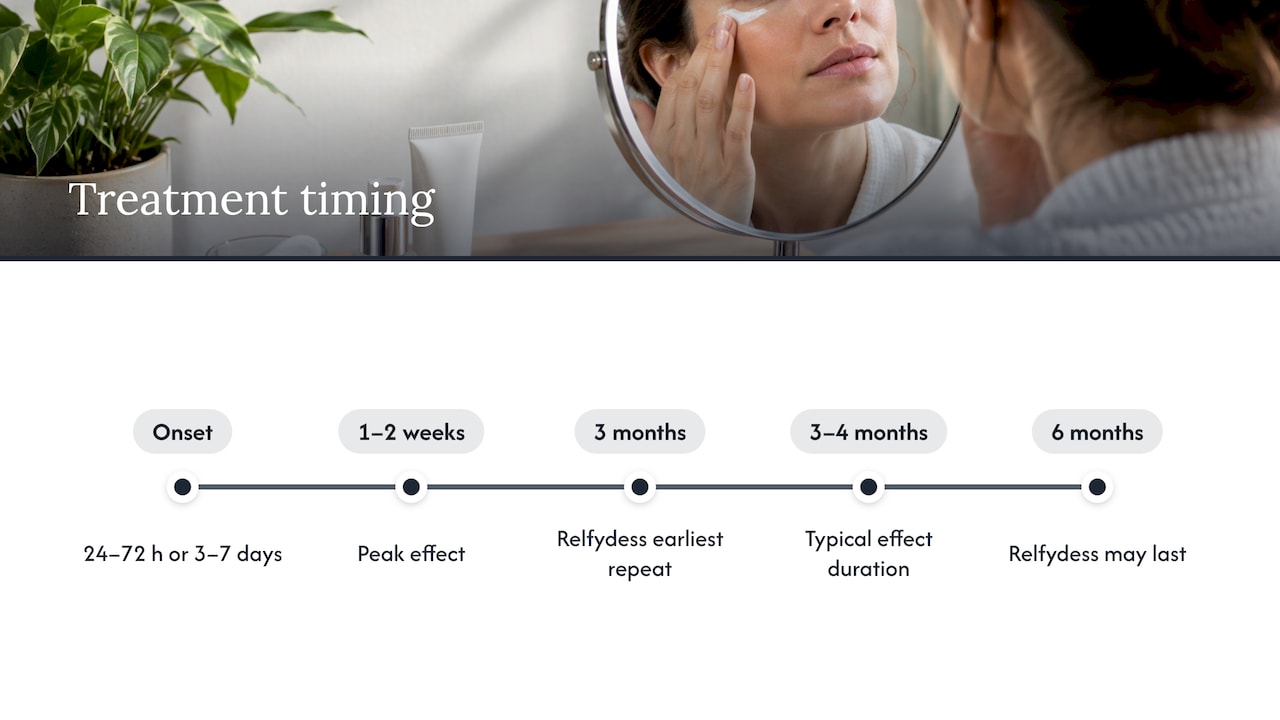
The British Cosmetic Dermatology Group says results typically appear in 3-7 days, peak around two weeks and last on average 3-4 months. BAAPS gives a similar picture: an effect within 24-72 hours, a maximum at one to two weeks, and a duration of approximately 3-4 months.
Some newer products are licensed with longer expectations. The UK patient leaflet for Relfydess, for example, says its effect may last six months, that it is for adults under 65 with moderate-to-severe lateral canthal lines (the medical name for crow’s feet), and that treatments should not be repeated more often than every three months. Which product suits you is a decision for your practitioner at consultation. For planning top-ups, see our Botox maintenance schedule.
Safety: what you should know before you book
Anti-wrinkle injections are a prescription-only treatment, and the safety points are straightforward when you know them.
Common, temporary effects. The Relfydess leaflet lists injection-site reactions, headache and upper-eyelid droop as common effects, affecting up to 1 in 10 people. Dry eyes and blurred vision are listed as uncommon, up to 1 in 100. The British Cosmetic Dermatology Group lists temporary redness, swelling, bruising, headache or a feeling of heaviness, with temporary asymmetry and eyelid or eyebrow droop less common.
Seek urgent medical attention if you have difficulty swallowing, speaking or breathing after treatment, as the Relfydess leaflet advises.
Who should not have treatment. BAAPS lists neuromuscular disorders such as myasthenia gravis, pregnancy or breastfeeding, infection or inflammation at the injection sites, bleeding disorders and some interacting medicines. The British Cosmetic Dermatology Group adds a known allergy to the ingredients, and calls for caution with medicines such as aminoglycoside antibiotics. Tell your practitioner about every medicine and condition at your consultation. For a fuller clinical view, read our page on whether anti-wrinkle injections are safe.
Who should be holding the syringe
This is the part of the decision that matters most. The British Cosmetic Dermatology Group says UK cosmetic botulinum toxin should be given by qualified, registered healthcare professionals with specific training, in a regulated clinical environment that has complication management and follow-up arrangements.
The wider market is changing. A February 2026 UCL report found that the share of UK botulinum-toxin practitioners without a medical background nearly doubled from 12% to nearly 25% between 2023 and 2025. It also noted that government plans for further licensing reforms had been announced, though the shape of future regulation was unsettled at the time.
One rule is already in force. Since 1 June 2025, nurse and midwife prescribers must hold a face-to-face consultation before prescribing for elective non-surgical cosmetic procedures, according to the JCCP’s summary of the Nursing and Midwifery Council position. Our explainer on Botox prescription rules in the UK covers who can prescribe and inject.
We are CQC-registered and members of the ACE Group, which is dedicated to patient safety, and all our treatments are performed by medically trained professionals.
Skincare for fine crow’s feet
Skincare cannot stop your muscles moving, but it improves the surface of the skin around them. The sensible daily foundation is sun protection, because sun exposure is one of the recognised contributors to lines, plus a good moisturiser.
Cleveland Clinic describes exfoliation, peptide creams and retinol as non-prescription options for fine lines. It also notes that retinol can irritate skin, especially when you first start or use high concentrations. In practice, that means introducing it slowly, a few evenings a week, and applying a small amount.
Prescription-strength retinoids are a step up and are clinician-supported. At The Aesthetics Room, a Medical Skincare Prescription is £50, which is a simple way to start a regime tailored to your skin rather than guessing in a shop aisle. Expect gradual change over months, and expect the effect to last only while you keep using the product.
Some people also look into red light therapy as a complementary wellness option alongside their skin routine.
Peels, microneedling and skin-quality treatments
When lines are fine and static, treatments that renew the skin make sense. Cleveland Clinic lists chemical peels among the clinician-supported options.
Our published prices:
- Mild Skin Peel: £120
- Medium / Deep Peel: £350
- Micro-needling: £300
- Vampire Peel (PRP): £450
- Profhilo: £350
- Sunekos: £450
Microneedling uses tiny, controlled punctures to prompt the skin to produce collagen, and is generally done as a course rather than a single session. A deeper peel brings more renewal but needs more recovery time than a mild peel, so your practitioner will match the depth to your skin and your calendar. Profhilo and Sunekos are injectable skin-quality treatments designed to improve hydration and the firmness of thin or crepey skin, which suits the delicate eye area where lines have started to linger.
A note on tear trough filler
People often assume that filler under the eye will smooth crow’s feet. It will not: tear trough filler treats hollows beneath the eye, not surface creases at the outer corners. If you have both concerns, they are treated separately. We cover that in our under eye filler guide and our tear trough filler recovery page.
Choosing the best treatment for your lines
Use this as a starting point, then confirm it at consultation:
- Lines only when you smile: anti-wrinkle injections, with daily SPF to protect the results.
- Lines visible at rest, with crepey texture: injections to relax the muscle, plus microneedling, a peel or a skin-quality treatment such as Profhilo.
- Very fine, early lines: a medical skincare routine with a prescription retinoid and SPF, with injections held in reserve.
- Dark or hollow under-eye area as well: treat that separately from the crow’s feet.
If you are comparing clinics, look at who will treat you, whether a proper consultation comes first, and what follow-up arrangements exist. Our guide to London aesthetic consultations explains what the appointment should cover.
Aftercare and what to do next
After injections, avoid rubbing or massaging the treated area, and follow your practitioner’s instructions on exercise and make-up. We cover both in exercising after Botox and make-up after treatments. For a deeper look at our approach to this area, see our page on the best crow’s feet treatments for natural results.
Our view on treating crow’s feet
We rarely treat crow’s feet as an isolated line. The eye area reflects how you move, how your skin has aged and how it has been looked after, so we build a bespoke plan around all three.
For most people that means relaxing the muscle that creates the smile line, then supporting the skin around it with the right medical-grade care. Natural results come from restraint: enough to soften, never enough to freeze your expression.
Every treatment is performed by medically trained professionals, in a CQC-registered clinic, and our membership of the ACE Group reflects how seriously we take patient safety. That is the standard we would want for our own faces.
Vishul
Book your crow’s feet consultation
At The Aesthetics Room, our anti-wrinkle treatment is £200-£358, and you can start with a virtual or in-person consultation at our Knightsbridge, Harley Street or Mayfair locations. We will assess whether your lines are dynamic, static or both, and set out a plan with the treatments that suit you.

See every published treatment and price on our price list, or visit The Aesthetics Room to book.
FAQ
At what age do most people get crow’s feet?
There is no single age. Cleveland Clinic notes that some people see them in their 30s while others do not notice them until their 40s. Sun exposure, genetics and how expressive your face is all influence the timing.
How long do results last for crow’s feet?
The British Cosmetic Dermatology Group says botulinum toxin results typically last 3-4 months on average, appearing in 3-7 days and peaking around two weeks. Some licensed products carry longer expectations, so your practitioner will advise on your own top-up timing.
How much does it cost to treat crow’s feet?
At The Aesthetics Room, anti-wrinkle treatment is £200-£358. Skin treatments for fine static lines include a Mild Skin Peel at £120 and Micro-needling at £300. The final recommendation and cost depend on your consultation.
How risky are anti-wrinkle injections around the eyes?
Common effects are temporary: redness, swelling, bruising and headache, with eyelid droop possible in up to 1 in 10 people according to the Relfydess leaflet. Treatment is not suitable in pregnancy, breastfeeding or with certain neuromuscular conditions. Choosing a qualified, registered professional in a regulated clinic is the key safety step.
Can crow’s feet be reversed with skincare?
Skincare can soften fine surface lines and help protect against sun damage, particularly daily SPF and retinoids used over several months. Lines driven by muscle movement respond best to anti-wrinkle injections, and we often combine the two.
Sources
- Crow’s Feet: What It Is, Botox, Treatment & Prevention, Cleveland Clinic
- Facial lines and wrinkles, DermNet
- Botulinum toxin injections, British Association of Aesthetic Plastic Surgeons
- Botulinum Toxin Injections, British Cosmetic Dermatology Group
- Relfydess 100 units/mL solution for injection, patient leaflet
- Rise of UK aesthetic botulinum toxin industry outpacing regulation, UCL
- Maintaining Your NMC PIN, JCCP