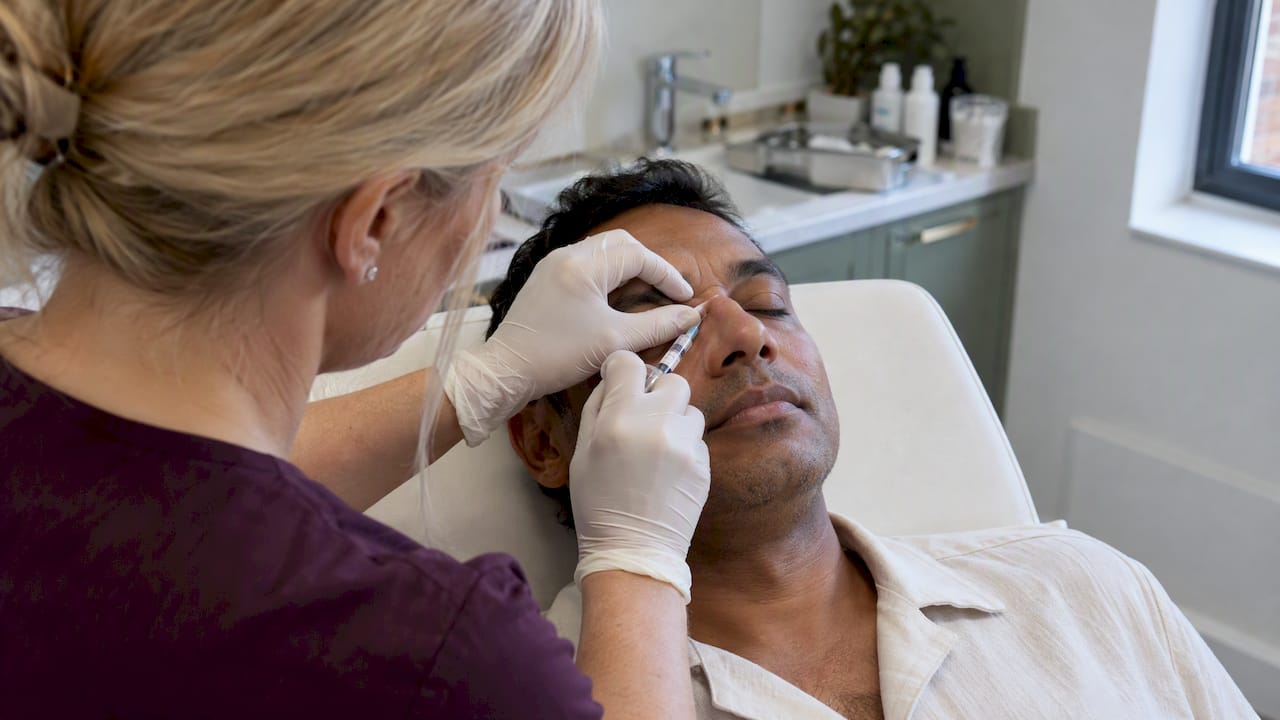

Liquid rhinoplasty, also called a non-surgical nose job, uses hyaluronic acid filler to reshape the nose without an operation. Most people get swelling, redness and bruising that settle within days. A small number get serious problems: blocked blood vessels, skin damage, lumps that appear months later, and in the worst reported cases, loss of vision. The nose is one of the riskiest places on the face to inject, so who treats you matters more than which product they use.
This guide sets out what can go wrong, how often, what recovery looks like and how to judge a clinic before you commit.
TL;DR
- Mild swelling, bruising and tenderness are common after nose filler and usually settle within about a week.
- Vascular occlusion, where filler blocks a blood vessel, is rare but is the key danger. It can lead to skin death and, in reported cases, permanent blindness.
- “Temporary” filler can linger for years and can make a later surgical rhinoplasty harder.
- Safety depends on the injector: medical training, anatomical knowledge, hyaluronidase on site and a clear emergency plan.
- Check CQC registration, insurance and qualifications, and treat unusually low prices as a warning sign.
Table of Contents
- What liquid rhinoplasty actually does
- Common side effects: what is normal
- Rare but serious complications
- Is it really temporary?
- What to expect after liquid rhinoplasty
- Why “botched” results happen
- How to choose a safe practitioner
- Our perspective
- Where our treatments fit
- FAQ
- Sources
What liquid rhinoplasty actually does
A practitioner injects small amounts of hyaluronic acid filler into precise points on the nose. The aim is to smooth a small bump, lift a drooping tip or even out a slight asymmetry. It adds volume. It cannot make a nose smaller, fix breathing problems or correct major structural issues, which is why it suits subtle changes only.
The appeal is obvious: it takes minutes, there is no general anaesthetic and there is no cutting. The trade-off is that the nose has a dense, delicate blood supply with very little room for error. That is where most of the risk sits.
Common side effects: what is normal
An NHS hospital patient leaflet describes common side effects of filler, seen in more than 1 in 20 patients, as pain, swelling, bruising and redness, which usually resolve within a week. For the nose, expect:
- Tenderness or a dull ache at the injection points.
- Redness that fades over a few days.
- Bruising, which can be more visible on pale skin and may need a little longer to clear.
- Swelling that can make the nose look slightly larger than the final result for several days.
These reactions are not unique to the nose. If you are comparing injectables, this overview of Botox side effects explained shows how bruising and soreness are typical of most injection treatments, and why unusual symptoms deserve a call to your practitioner.
Normal swelling is even, gradual to settle and not accompanied by severe pain. If your symptoms are getting worse rather than better, that is the point to contact the clinic, not wait.
Rare but serious complications
Vascular occlusion
This is the complication every nose filler patient should understand. Filler can be injected into, or press on, a blood vessel and cut off the blood supply to the skin. The Aesthetic Complications Expert (ACE) Group guidance calls it the most severe and feared early complication in aesthetic treatment.
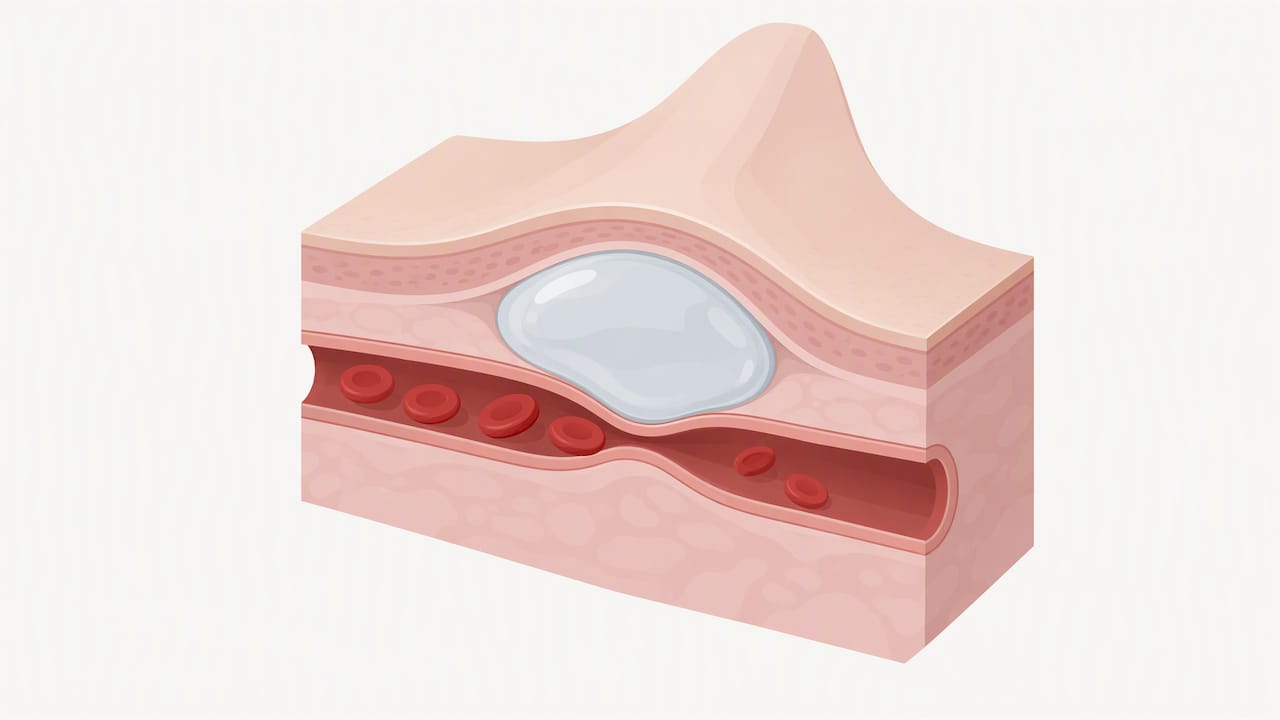
The overall incidence after dermal filler is estimated at 0.001%, or 1 in 100,000 cases. That figure is an estimate for filler in general, and the nose is not an average site. A systematic review of ocular complications found the nose accounted for 40.67% of cases in one study, and reported vision loss as the most severe, potentially irreversible event.
Warning signs include:
- Intense or disproportionate pain during or after treatment.
- Skin that turns pale, white, blotchy or dusky.
- A blue-grey or mottled appearance spreading across the nose or cheeks.
- Any sudden change in vision.
Some of these can appear later than you would expect. The ACE Group notes that symptoms usually show immediately, but delayed symptoms can occur hours or even days later. A clinic should tell you the red flags before you leave and give you an emergency contact.
If you notice sudden vision changes, severe pain or skin discolouration after nose filler, contact your practitioner immediately. If you cannot reach them, go to A&E or call 999. Do not wait for a review appointment.
Skin necrosis
If blood flow is not restored quickly, the skin can die, leaving scarring or lasting marks. This is the complication that often turns “a small tweak” into months of treatment, and it is why the nose tip and sides of the nose need such careful technique.
Blindness
This is extremely rare, but it is documented. A case report in the medical literature describes a 32-year-old woman who developed sudden unilateral blindness and orbital pain immediately after hyaluronic acid filler to the nose. Filler can travel backwards along small arteries towards the eye, which is why anatomical knowledge and injection technique matter so much.
Time is critical. According to the ACE Group protocol, some guidance suggests giving hyaluronidase within four hours, while experimental evidence indicates retinal damage may become irreversible in as little as 12 to 15 minutes. You cannot judge this yourself, so the practical step is to choose someone who keeps the right emergency kit and knows how to use it.
Lumps, infection and delayed reactions
The same NHS leaflet notes that nodules, granulomas or hypersensitivity reactions can appear weeks or months after treatment and may need medical care. It also cites roughly a 1% incidence of adverse reactions such as sterile abscesses even with hyaluronic acid products. So “temporary” does not mean “risk-free”.
- Infection: redness, heat, increasing pain or pus need prompt assessment.
- Lumps and irregularities: can often be softened or dissolved, but not always straightforwardly.
- Asymmetry or overfilling: a nose that looks wider, shinier or “pinched” at the tip.
Is it really temporary?
Most people choose nose filler because it is not permanent. The reality is more nuanced. Moorfields Private’s ophthalmology team, writing about under-eye filler, points out that filler does not always break down on the manufacturer’s timeline, and that residual product can cause congestion, swelling and tethering. The same logic applies to other facial areas, and it matters for the nose.
The practical consequence: if you might want surgical rhinoplasty one day, tell your practitioner and your surgeon about every filler session. Surgeons caution that residual filler can make dissection more complex and less predictable. Dissolving filler with hyaluronidase beforehand is a conversation to have with your surgeon, not a step to take on your own.
What to expect after liquid rhinoplasty
Recovery is short, but it is not nothing. A typical timeline, based on the common side effects above:
| Time | What you may notice | What to do |
|---|---|---|
| Same day | Tenderness, mild redness, slight swelling | Follow your practitioner’s aftercare, keep your hands away from the nose |
| Days 1 to 3 | Swelling peaks, possible bruising | Avoid pressure on the nose, including heavy glasses where advised |
| Days 4 to 7 | Most redness and swelling settles | Contact the clinic if things are worsening, not improving |
| Weeks 2 to 4 | Shape settles | Review with your practitioner; do not have top-ups without assessment |
| Months later | Lumps, tenderness or changes in shape | Report to your practitioner or GP |
This table is a general guide. Your practitioner’s own aftercare instructions come first, and anything outside this pattern, particularly pain, colour change or visual symptoms, needs urgent attention as described above.
Why “botched” results happen
Searches for botched results are common because the failures are visible: a broad, shiny or bumpy nose, or tissue damage. The causes usually fall into a few groups:
- Wrong patient. Filler suits small, defined changes. It does not suit a wish to make the nose smaller overall, thick skin that cannot be reshaped by volume, or major deformities.
- Too much product. Overfilling widens the nose and increases pressure on blood vessels.
- Insufficient anatomical knowledge. The nose sits on a web of small vessels linked to the eye and forehead.
- No complication plan. Without hyaluronidase to hand, a treatable problem becomes a lasting one.
- Non-clinical settings. Treatments in homes, pop-ups or beauty spaces, at low prices, are the pattern surgeons warn about.
The British Association of Aesthetic Plastic Surgeons has long argued that non-surgical does not mean non-medical: the question is not who can hold a syringe but who can deal with the complications.
How to choose a safe practitioner
The law in England is still catching up. The government has said it is advancing a licensing scheme for non-surgical cosmetic procedures under the Health and Care Act 2022, and urges consumers to check qualifications, insurance and registrations before booking. Until that scheme is in force, the checking is on you.
Ask these questions before any nose treatment:
- Who exactly will treat me, and what is their medical training? You want a regulated healthcare professional, with their registration checkable.
- Is the clinic CQC-registered? The Care Quality Commission register is public.
- Are they insured for this treatment? Ask for proof.
- Do you keep hyaluronidase on site, and what is your protocol for a suspected vascular occlusion? A competent answer is specific and immediate.
- What will I be told about warning signs, and who can I call out of hours?
- Do you advise against treatment sometimes? A good practitioner says no when filler is not the right answer.
- Why is the price what it is? Suspiciously low pricing often signals a lack of clinical oversight, as government advice also warns.
Be wary of anyone who calls the procedure “risk-free”. Several clinic pages make that claim. The medical literature does not.
Our perspective
We are a CQC-registered medical aesthetics clinic and members of the ACE Group, and that shapes how we think about nose filler. Our view is simple: the nose is not a place for a casual appointment, and a treatment is only as safe as the plan behind it.
Here is how we approach any facial injectable, nose or otherwise:
- Medical assessment first. We look at your anatomy, your history and what you want to change, including whether filler is the right tool at all.
- Honest advice. If your goals need surgery, or if a smaller, safer treatment elsewhere on the face would give a better balance, we say so.
- A complication plan before the needle. Knowing the signs of vascular compromise and how to act is non-negotiable, and so is telling you what to watch for afterwards.
- Natural, bespoke results. We would rather under-treat and review than overfill.
As a reader, take that standard with you to any clinic you consider. If a practitioner cannot answer the questions in the section above clearly, keep looking.
— Vishul
Where our treatments fit
If you are exploring injectables and want an assessment from medically trained, CQC-registered practitioners, you can see our full treatment price list before you book. It includes Lip Filler at £215-£300, Tear Trough at £360, Jaw Definition & Contouring at £310 and Anti Wrinkle at £200-£358, among other treatments. You can also start from our clinic homepage and arrange an in-person or virtual consultation to talk through your goals and any concerns.
FAQ
How risky is liquid rhinoplasty compared with surgery?
They carry different risks. Surgery involves anaesthesia, a longer recovery and a permanent change. Liquid rhinoplasty is quicker, but filler in the nose carries a small risk of vascular occlusion, which can cause tissue damage or vision loss. Neither is risk-free, and the skill of the practitioner is the biggest factor either way.
How long do the side effects last?
Common effects such as swelling, bruising and redness usually settle within about a week, according to an NHS patient leaflet. Lumps or reactions can appear weeks or months later, so tell your practitioner if anything changes.
Can nose filler be dissolved if I don’t like it?
Hyaluronic acid filler can usually be dissolved with hyaluronidase, which is also the emergency treatment for vascular occlusion. Dissolving should be done by a trained professional after assessment. Residual product may remain longer than expected, which is worth knowing if you plan future surgery.
What are the warning signs I should act on straight away?
Severe or increasing pain, pale, white or dusky skin, a mottled pattern, or any change in vision. The ACE Group stresses that patients should be told these red flags and seek emergency help rather than wait for a follow-up. Contact your practitioner, and go to A&E or call 999 if you cannot reach them or your vision is affected.
Sources
- ACE Group: Management of a vascular occlusion
- ACE Group: The use of hyaluronidase in aesthetic practice
- Ocular complications post-cosmetic periocular hyaluronic acid injections: a systematic review
- Orbital infarction syndrome following hyaluronic acid filler rhinoplasty
- Chelsea and Westminster NHS patient leaflet on filler complications
- Moorfields Private: the 5 key risks of under-eye filler injections
- BAAPS: Injecting some sense into dermal fillers debate
- GOV.UK: Crackdown on unsafe cosmetic procedures