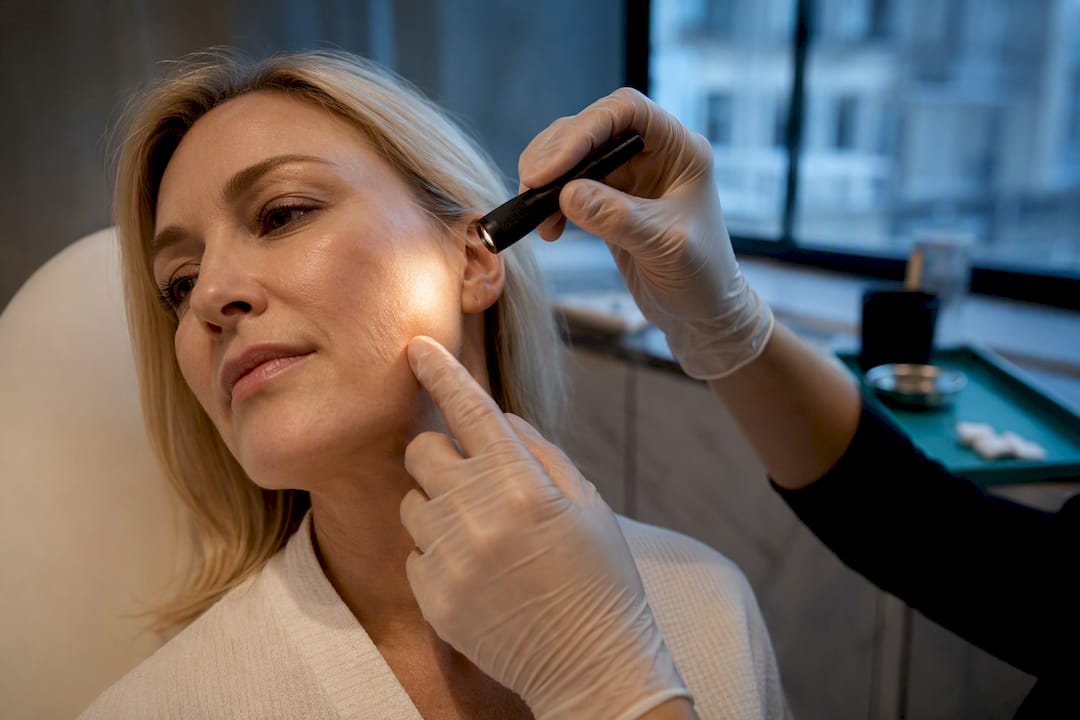
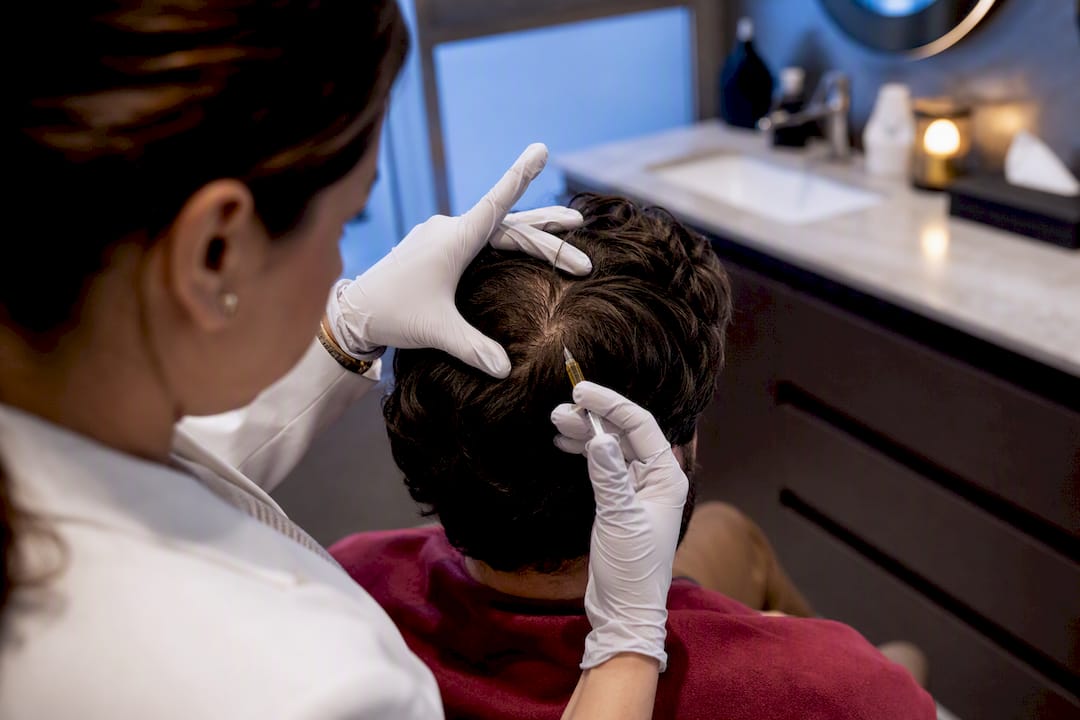

Most people notice their first genuine change within a few months, with clearer improvement often by half a year and peak density gains generally stabilizing within the first year. Clinical evidence backs this window: trichogram-based research shows measurable hair-count increases from three months, with the strongest gains visible at six. Responses vary considerably from person to person, and most patients need periodic maintenance sessions to hold onto their results long-term.
TL;DR:
- Visible hair density improvements typically begin around three to six months, with individual responses influenced by age, genetics, and treatment protocol details.
- Shedding may temporarily increase during the first eight weeks due to follicle reset but usually subsides, leading to the appearance of finer, newer hairs along the hairline.
- Clinical data show an average increase of around 8.4% in hair density at three months, rising to over 19% by six months, though some patients may experience a short-term decline before improvement.
- Maintenance or booster sessions every six to twelve months are usually necessary to preserve gains, especially if shedding begins to increase again or styling coverage thins.
- The timing of results varies by hair loss pattern, with androgenetic alopecia typically responding within three to six months, while autoimmune conditions like alopecia areata have less predictable timelines.
Table of Contents
- Hours to day two: what happens straight after your PRP session
- Weeks 1 to 8: the quiet phase and first hints of change
- Months 2 to 3: the first measurable numbers and a possible dip
- Months 3 to 6: thickness returns and clinics take stock
- Months 6 to 12: peak results, and why some people need a top-up
- What affects how quickly you see results
- A common PRP programme and how clinicians judge progress
- Aftercare: practical do’s and don’ts to protect your results
- How a CQC-registered clinic frames timelines and assessments
- Week-by-week milestones you can actually track
- How PRP timelines differ by type of hair loss
- Author checklist: questions to ask at your consultation
- Ready to start your own PRP timeline?
- Sources
- FAQ
Hours to day two: what happens straight after your PRP session
Expect some redness, small raised bumps at injection points and mild scalp tenderness immediately after treatment. Occasional bruising can occur, but nearly all of these signs settle within 24 to 48 hours.
- Wait a minimum of six hours before washing your hair; many clinics recommend waiting the full 24 hours
- Avoid touching or scratching the treated scalp while it settles
- Return to normal daily activities the same day, but hold off on vigorous exercise until the next day
None of these early reactions predict how well the treatment will work. They’re simply your scalp responding to the injections themselves, not a signal of the PRP therapy working or failing.
Weeks 1 to 8: the quiet phase and first hints of change
This stretch tests patience more than anything else. Some patients notice a temporary increase in shedding during weeks two to four, a phenomenon called telogen effluvium, where resting-phase hairs release to make way for new growth. It looks alarming, but it’s a normal part of the follicle reset that PRP triggers.
By week six to eight, the earliest positive signs tend to appear:
- Shedding gradually reduces from its earlier peak
- The scalp itself often looks and feels healthier, less flaky or tight
- Fine, short vellus hairs (sometimes called baby hairs) start appearing along the hairline and part line
Tracking this stage properly matters more than most people realise. Frequent hair-pull tests or squinting in different mirrors gives you an unreliable, emotionally skewed picture.
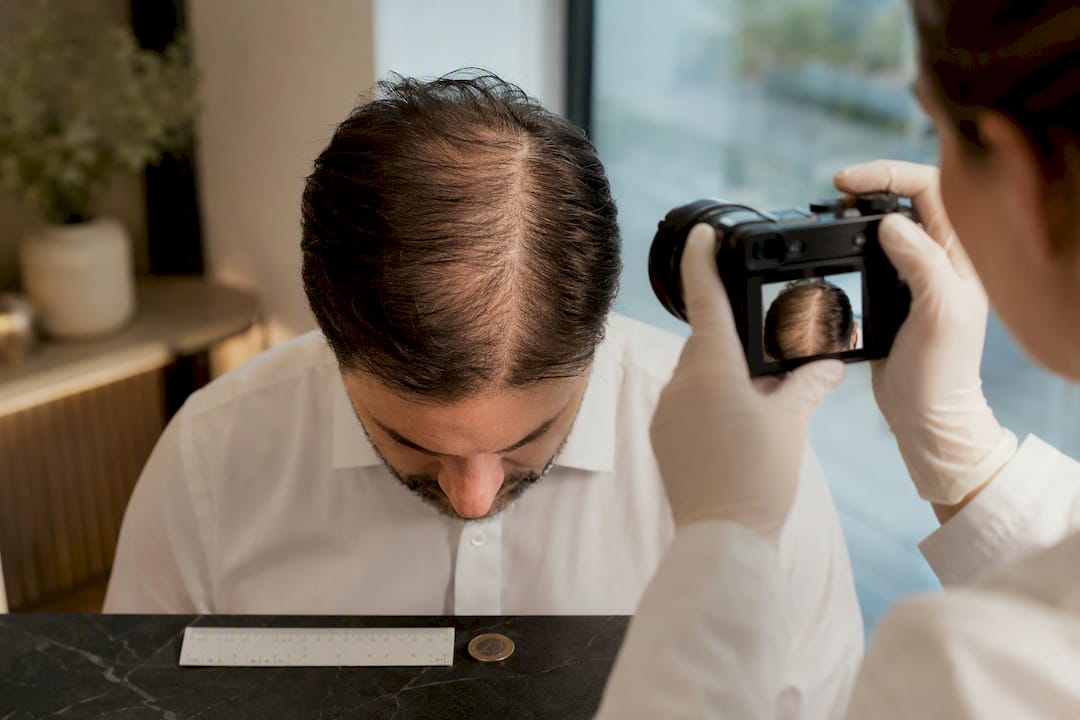
Pro Tip: Take a baseline photo before your first session using the same room, same light source, and same camera distance. Repeat it every four weeks from a fixed angle, ideally with a ruler or coin in frame for scale. This is the single easiest way to see real change instead of imagining it.
Months 2 to 3: the first measurable numbers and a possible dip
This is where clinical data starts to matter more than anecdote. A randomised, evaluator-blinded trial using computerised trichograms recorded a mean increase of 33.6 hairs in the treated area after three sessions, with density gains reaching statistical significance at the three-month mark.
By the numbers: Separate trial data using AI-assisted trichoscopy recorded an 8.4% increase in hair density at three months, rising to 19.1% by six months when measured against baseline.
Some patients experience a short-lived uptick in shedding again around this point before regrowth accelerates. It’s frustrating when it happens, but it typically resolves within a few weeks. The vertex and frontal scalp tend to respond earlier than the crown or diffusely thinning areas, likely because follicle density and blood supply differ across the scalp.
Months 3 to 6: thickness returns and clinics take stock
This window is where most patients start believing the treatment is genuinely working, and the clinical literature agrees. ISHRS guidance states that while some change can appear within one to two months, most noticeable results arrive realistically between three and six months.
By the numbers: The same AI-trichoscopy trial recorded density gains rising from 8.4% at three months to 19.1% at six months, more than doubling the improvement over that period.
Clinics typically formalise assessment at this stage using objective measurement tools rather than relying on the patient’s own impression:
- Phototrichograms or trichoscopy with fixed reference points, which give repeatable density readings session to session
- Standardised global photography under consistent lighting
- Patient-reported changes in styling ease, scalp coverage and shedding volume
Patients commonly describe stronger, thicker individual hair shafts, a scalp that shows through less under bright light, and hairstyles that finally hold volume again. If density gains plateau or feel underwhelming by month six, this is typically when clinicians discuss booster sessions or adjunctive treatments rather than waiting further.
Months 6 to 12: peak results, and why some people need a top-up
Most patients reach their peak cosmetic improvement somewhere in this window. The half-head trial referenced earlier found clear density gains held through six months, though a minority of patients showed relapse by 12 to 16 months and needed retreatment to maintain their results.
- Peak density and thickness usually stabilise between months six and twelve
- Maintenance sessions every six to twelve months are commonly recommended to preserve gains rather than let them fade
- A booster aims to sustain follicle activity, not restart the process from scratch
Retreatment becomes worth discussing when shedding creeps back up, when new photos show density dropping compared with the six-month mark, or when styling coverage starts to feel thinner again. Continued monitoring alone is usually sufficient if photos and hair counts remain stable. Durability varies enormously between patients, which is exactly why a single course of three sessions is rarely presented as a one-off, permanent fix.
What affects how quickly you see results
Several variables explain why two people having what looks like the same treatment can see very different timelines.
- Patient factors: age, the stage of hair loss at treatment, genetics, smoking status, nutritional deficiencies and hormonal conditions all influence how well follicles respond
- Protocol factors: platelet concentration, whether the PRP is activated, the centrifuge and preparation method used, and the total number of injections per session
- Combination treatments: minoxidil, finasteride, microneedling or a prior hair transplant can all change the timeline, usually by accelerating or amplifying PRP’s effect rather than replacing it
Finasteride is FDA-indicated for men only. Women who are or may become pregnant must not handle crushed or broken finasteride tablets, due to the risk of harm to a male fetus. It can also cause sexual side effects (reduced libido, erectile dysfunction) in a minority of men, which usually resolve after stopping treatment. Discuss these risks with a physician before starting.
Research comparing protocols found that higher platelet concentrations and activator use tend to correlate with greater density gains at four to six months, with one trial recording density increases up to 42% in the highest platelet-count group by that stage. This is a fair question to raise directly with any clinic before you commit to a course, since not all PRP preparation methods are equal.
A common PRP programme and how clinicians judge progress
Most evidence-based protocols follow a similar structure, and it’s worth knowing it before you book.
- Three initial sessions, spaced roughly four weeks apart, to build an initial response
- A formal review at three to six months, using photos, hair-count comparisons and your own reported changes in shedding and coverage
- Booster sessions every six to twelve months, depending on how well the initial results are holding
A typical session runs 30 to 60 minutes including blood draw, centrifuge processing and injection. The four-week gap between initial sessions isn’t arbitrary. It allows the scalp to recover and follicles time to respond before the next stimulus. Review visits usually combine a visual scalp check with side-by-side photo comparison against your baseline images, which is exactly why that first-session photo matters so much.
Aftercare: practical do’s and don’ts to protect your results
Good aftercare is unglamorous but it genuinely protects your investment.
- Avoid washing your hair for at least six hours, ideally 24, after treatment
- Skip strenuous exercise, saunas, steam rooms and alcohol for 24 to 48 hours
- Flag any blood-thinning medication, including regular NSAID use, with your clinician before treatment, since these can increase bruising
- Expect mild soreness for a day or two; this is normal and not a sign of a problem
Pro Tip: Book PRP sessions on a day where you don’t need to style your hair immediately after, and keep the treated area away from hot showers and hairdryers on high heat for the first 24 hours.
Contact your clinic promptly if you notice spreading redness, discharge, fever or pain that worsens rather than eases after two days. These aren’t typical PRP reactions and warrant a proper check. For a fuller breakdown of what’s expected versus what isn’t, side effect guidance is worth reading before your first appointment.
How a CQC-registered clinic frames timelines and assessments
At The Aesthetics Room, every PRP pathway starts with a proper consultation and baseline photography, not a generic protocol applied to everyone who walks in. That baseline matters enormously, because it becomes the reference point every future review is measured against.
Treatment plans are built around your specific pattern of thinning, with scheduled reviews rather than a vague “come back if you’re worried” approach. As a CQC-registered clinic and member of the ACE Group for patient safety, the practice documents progress consistently and sets timelines tailored to each patient’s stage of hair loss and response pattern, rather than promising a fixed result on a fixed date.
Week-by-week milestones you can actually track
Breaking the first two months down further helps set realistic expectations rather than checking the mirror daily and feeling discouraged.
Week 1: Scalp sensitivity fades within days. No visible hair change yet, and none should be expected this early.
Weeks 2 to 3: Some patients notice a short burst of shedding as dormant follicles reset. This is uncomfortable to watch but consistent with how PRP is understood to nudge follicles back into an active growth phase.
Weeks 4 to 6: Shedding typically settles. This is usually when the second treatment session in a standard three-part course takes place.
Weeks 6 to 8: Fine vellus hairs often appear at the hairline and along thinning patches, easiest to spot in your fixed-angle photos rather than the mirror.
Weeks 8 to 12: The third initial session usually happens here. Early trichogram measurements can start showing statistically meaningful density change, matching the three-month benchmark reported in clinical trials.
Beyond three months, milestones shift from weekly to monthly, because follicle cycling genuinely slows down at this stage; hair cannot grow faster than its own biological cycle allows, regardless of how well the treatment is working underneath. This is why patience through the middle months matters more than obsessive week-to-week comparison.
How PRP timelines differ by type of hair loss
Not every hair loss pattern responds at the same pace, and it helps to know where you sit before you compare your progress to someone else’s story.
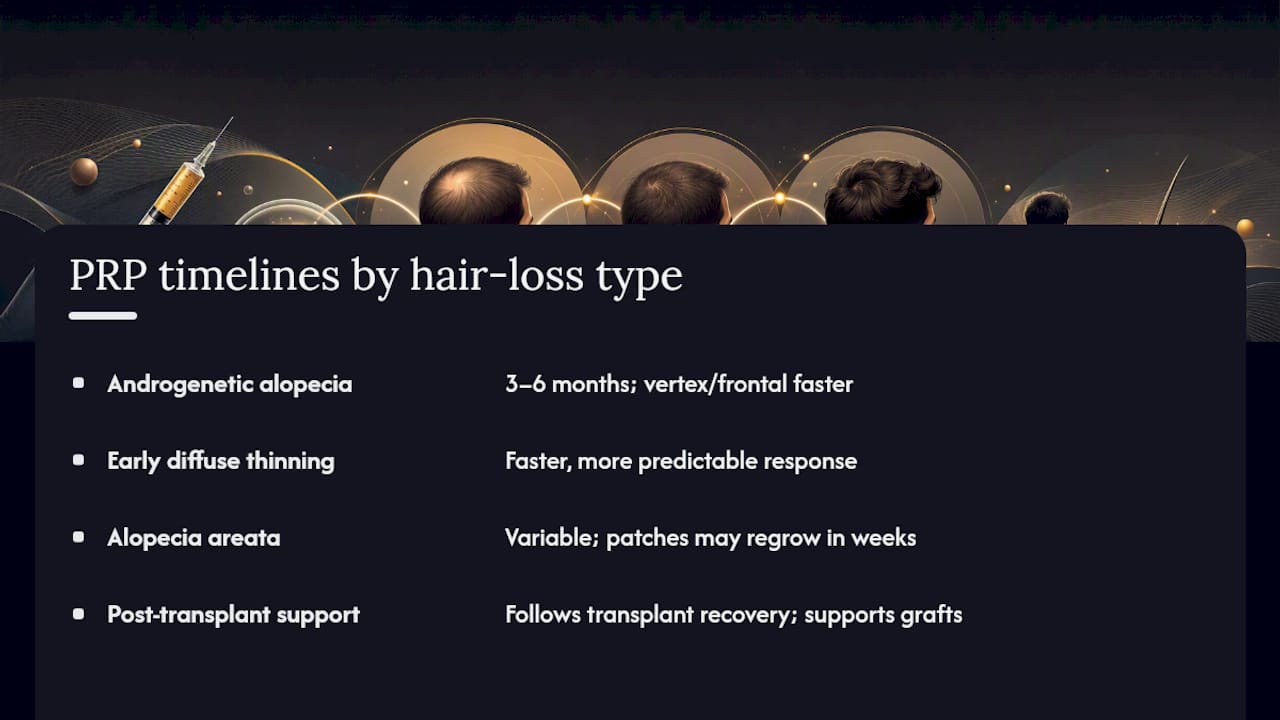
Androgenetic alopecia (pattern hair loss) is the most studied use of PRP and the source of most trial data referenced throughout this article. Response typically follows the standard three-to-six-month curve, with the vertex and frontal scalp often responding a little faster than diffusely thinning crown areas.
Early diffuse thinning, caught before significant miniaturisation has occurred, tends to respond somewhat faster and more predictably than advanced, long-standing pattern loss. This is one reason clinicians generally advise against waiting years before seeking treatment.
Alopecia areata, an autoimmune condition rather than pattern loss, behaves less predictably with PRP. Some patients see faster regrowth in patches within weeks, while others see minimal change, reflecting the different biological mechanism driving the hair loss in the first place.
Post-transplant support is a slightly different use case again. PRP alongside a transplant is often timed to support graft survival and early growth rather than to reverse thinning on its own, so the visible timeline blends with the transplant’s own recovery curve rather than following the standalone PRP schedule.
The common thread across all of these is that PRP encourages follicles already capable of growth to become more active. It doesn’t create new follicles, which is precisely why the underlying cause and stage of hair loss shapes how much change is realistically possible.
Author checklist: questions to ask at your consultation
Before booking, ask exactly how the platelet concentration is prepared and measured, and how progress will be tracked, ideally trichoscopy rather than casual photos. Ask what timeline applies to your specific pattern of loss, not a generic average. Treat clinic photos with scepticism unless lighting, angle and timing are consistent, and don’t hesitate to seek a second opinion if a clinic promises results faster than the evidence supports.
— Vishul
Ready to start your own PRP timeline?
The Aesthetics Room takes a different starting point from a generic hair loss clinic churning through templated protocols: every plan begins with baseline photography and a genuine assessment of your specific pattern of thinning, so the timeline you’re given actually reflects your case rather than an industry average.

A first consultation includes a full scalp assessment, baseline photo documentation for future comparison, and a bespoke treatment plan built around your stage of hair loss and goals. Reviews are scheduled rather than left to chance, so you always know what stage you’re at and what to expect next. If you’re ready to find out where you’d realistically land on this timeline, book a consultation with The Aesthetics Room and get a plan built around your own scalp, not a generic average.
This article is general information, not a substitute for advice from a qualified doctor. Consult a qualified healthcare professional about your own circumstances before acting on anything here.
Sources
- Effects of platelet-rich plasma on hair growth using computerized trichograms and Ki67 analysis (PMC)
- PRP therapy treatment plan and timeline — Traya
- Platelet-rich plasma guidance — ISHRS
- AI trichoscopy and Ki67 analysis study (Stem Cells Translational / CDR DOI)
- PRP recovery guide — MyHairline
FAQ
How long after PRP will I see hair growth?
Most patients notice their first subtle signs, like reduced shedding and fine new hairs, within one to three months, with clearer density change typically visible by three to six months.
Is two sessions of PRP enough?
Two sessions can produce some early change, but most clinical protocols and trial data are built around three initial sessions spaced roughly four weeks apart, followed by scheduled boosters, because density gains typically build progressively across that course.
How much is three sessions of PRP?
Pricing varies by clinic, protocol and location, so it’s not something to state as a fixed figure; ask any clinic you’re considering, including The Aesthetics Room, for a personalised quote at consultation.
What are the do’s and don’ts after hair PRP?
Wait at least six hours (ideally 24) before washing your hair, avoid strenuous exercise, saunas and alcohol for 24 to 48 hours, and contact your clinic if you notice spreading redness, discharge or worsening pain beyond the first two days.