


TL;DR:
- Facial asymmetry is universal, with every person displaying some degree of imbalance. It results from genetic, developmental, habitual, traumatic, or age-related factors, especially affecting the central features like the nose, eyes, and mouth. Non-surgical treatments such as Botox and fillers effectively correct soft tissue or muscle imbalances, emphasizing harmony over perfect symmetry.
No human face is perfectly balanced. In fact, every face has measurable asymmetry, and high-precision 3D scanning confirms this applies to 100% of people studied. Yet most of us fixate on perceived flaws, comparing our reflection to an impossible standard. Understanding what is facial asymmetry, where it comes from, and what can realistically be done about it, gives you something far more useful than reassurance. It gives you clarity. This article covers the science, the causes, the effects on perception, and the treatment options worth knowing about.
Table of Contents
- Key takeaways
- What is facial asymmetry?
- Causes of facial asymmetry
- How asymmetry affects appearance and confidence
- Facial asymmetry treatments: what actually works
- Assessing your own asymmetry: what to know
- My perspective on facial asymmetry
- Restore balance with Theaestheticsroom
- FAQ
Key takeaways
| Point | Details |
|---|---|
| Asymmetry is universal | Every person has some degree of facial asymmetry; perfect symmetry does not exist in nature. |
| Multiple causes contribute | Genetics, skeletal development, dental alignment, and daily habits like chewing and sleeping position all shape facial balance. |
| Central features matter most | Asymmetries in the eyes, nose, and mouth have the greatest impact on how others perceive your face. |
| Minor asymmetry goes unnoticed | Research shows small deviations rarely affect attractiveness ratings; only pronounced differences register consciously. |
| Non-surgical options are effective | Botox and dermal fillers can restore visual balance without surgery and with minimal recovery time. |
What is facial asymmetry?
Facial asymmetry refers to differences between the left and right sides of a face. The face is organised around a central vertical axis called the facial midline. Bilateral symmetry describes how closely the two halves mirror one another. In practice, no face achieves this perfectly, and that is entirely normal.
Researchers classify asymmetry into three categories:
- Fluctuating asymmetry: Random, unpredictable differences between the two sides. This is the most common type and is generally attributed to developmental stress or environmental pressures during growth.
- Directional asymmetry: A consistent, population-wide tendency for one side to be larger or more developed than the other. The lower jaw, for instance, tends to show mild directional asymmetry across most people.
- Antisymmetry: When asymmetry itself is expected and functional, such as the positioning of internal organs. This is less relevant to visible facial features but worth understanding conceptually.
The features most commonly affected include the jaw, nose, eyes, eyebrows, ears, and the soft tissues surrounding them. Interestingly, asymmetries in the central facial triangle, the region bounded by the eyes, nose, and mouth, have a disproportionate effect on how your face is perceived overall.
| Facial feature | Common asymmetry type | Typical cause |
|---|---|---|
| Jaw | Directional or structural | Skeletal growth, dental occlusion |
| Nose | Fluctuating or trauma-related | Development, injury, septal deviation |
| Eyes | Soft tissue or bony | Orbital differences, muscle tone |
| Eyebrows | Soft tissue | Muscle habits, age-related changes |
| Ears | Fluctuating | Developmental variation |
Modern assessment uses landmark-based measurements and imaging to precisely map these differences and guide personalised treatment planning.
Causes of facial asymmetry
Understanding the causes of facial asymmetry helps separate what is inherited from what develops over time, and that distinction matters when considering any intervention.
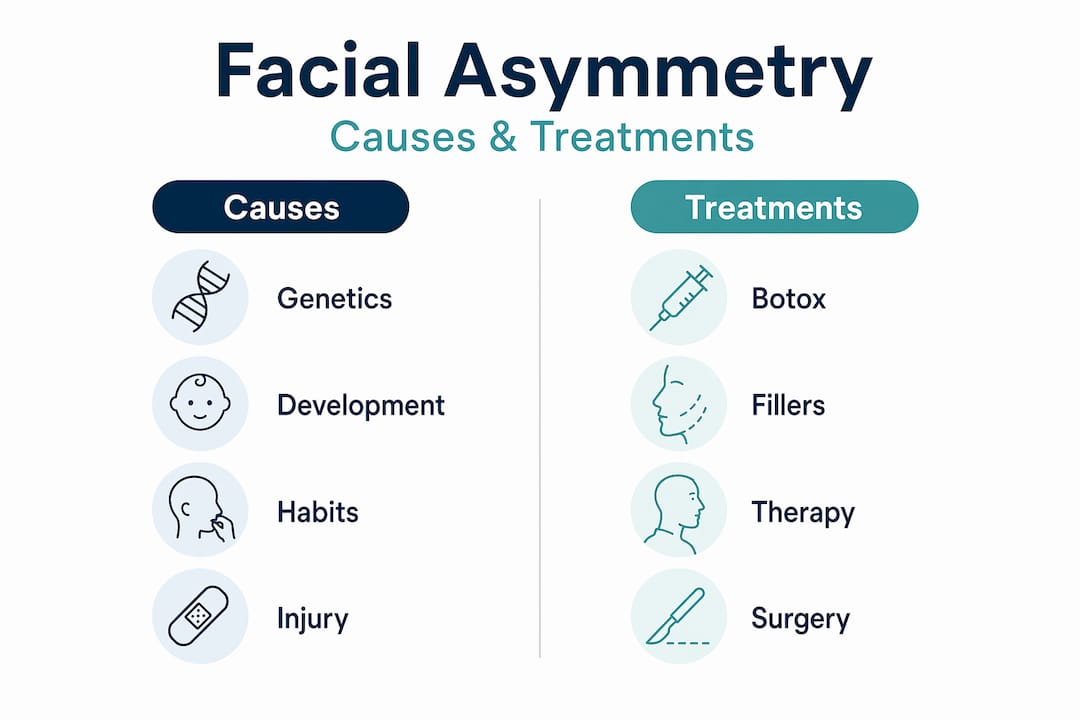
Congenital and genetic factors account for a significant portion of structural asymmetry. The way your facial bones grow during foetal development and throughout childhood sets a baseline that no amount of skincare or exercise can fully alter. Conditions such as hemifacial microsomia, where one side of the face is underdeveloped, represent pronounced congenital cases. Milder genetic variations are simply part of your blueprint.
Skeletal and dental development play an equally significant role. The upper and lower jaws grow independently, and any imbalance in their development, whether from tooth loss, malocclusion, or jaw joint issues, can produce visible asymmetry. Orthodontic problems that go untreated through adolescence often show up as facial imbalances in adulthood.
Functional habits are perhaps the most underappreciated cause. Unilateral chewing and side sleeping gradually shift soft tissue and even bone over time. Consistently sleeping on the same side compresses facial structures repeatedly, night after night, across years. The cumulative effect is measurable. Mouth breathing and poor tongue posture, where the tongue rests against the bottom of the mouth rather than the palate, are also clinically associated with asymmetric skeletal and soft tissue development.
Trauma and ageing add further complexity. An old facial injury, even a seemingly minor one, can alter bone structure or healing patterns. Ageing contributes its own asymmetry as fat pads deflate unevenly, muscle tone changes at different rates on each side, and skin laxity varies with sun exposure and lifestyle.
Pro Tip: If you notice asymmetry worsening over time rather than remaining stable, consider whether a habitual behaviour such as chewing predominantly on one side or sleeping with your face pressed into a pillow could be a contributing factor.
How asymmetry affects appearance and confidence
The relationship between symmetry in facial features and attractiveness is more nuanced than popular culture suggests. Yes, symmetry is associated with perceived health and genetic fitness. But it is not the only variable at play. Facial averageness and sexual dimorphism both contribute significantly to attractiveness independent of symmetry.

What research does confirm is that there are thresholds involved in perception. A 2024 study found that minor deviations in symmetry are frequently unnoticed by observers. Only when asymmetry crosses a certain threshold does it begin to register consciously and affect ratings. That is genuinely reassuring information for the vast majority of people concerned about their faces.
That said, where asymmetry appears does matter. The effects of facial asymmetry are felt most acutely in the central facial triangle. An eye-tracking study found that unattractive nose positioning causes observers’ gaze to shift in ways that alter the perception of the entire face. The nose, sitting at the centre of the face, acts as an organising feature for how others read your appearance.
Here is how perception of asymmetry tends to play out in practice:
- Very minor asymmetry: Undetectable to most observers; has essentially no impact on attractiveness ratings.
- Moderate asymmetry: May be noticed in photographs or video more than in person; can influence self-perception more than external perception.
- Pronounced asymmetry: Likely to be noticed, particularly in the jaw or nasal area; more significant functional implications alongside aesthetic ones.
- Extreme asymmetry: Typically associated with congenital or trauma-related causes; often requires both functional and aesthetic intervention.
The psychological dimension deserves equal attention. Many people experience distress about asymmetry that others around them simply cannot detect. Medical professionals rate symmetry differently than laypersons, with clinicians consistently perceiving greater symmetry and attractiveness in faces than untrained observers. This gap matters because it means your self-assessment of your own asymmetry may be more critical than any objective measurement would support.
Facial asymmetry treatments: what actually works
There is no single answer to how to fix facial asymmetry because the right approach depends entirely on the type and cause. That said, the options available in 2026 are genuinely effective, particularly for those seeking aesthetic improvement without surgery.
Non-surgical options are the most popular starting point, and for good reason.
- Botox (botulinum toxin): Botox treats asymmetry by relaxing overactive muscles on one side of the face, reducing the appearance of uneven brow position, jawline differences, or asymmetric lip movement. Results are precise when administered by a skilled practitioner.
- Dermal fillers: Hyaluronic acid fillers restore volume to deflated or underdeveloped areas, correcting soft tissue imbalances in the cheeks, lips, or chin. They work particularly well for age-related asymmetry where fat loss is uneven.
- Combination treatments: Many clients achieve the best results through a tailored plan that combines Botox for muscle-related asymmetry with fillers for structural volume differences. Non-invasive treatments like these can significantly enhance facial harmony without recovery time.
| Treatment | Best for | Longevity |
|---|---|---|
| Botox | Muscle imbalance, brow asymmetry, jaw | 3 to 6 months |
| Dermal fillers | Volume loss, soft tissue differences | 9 to 18 months |
| Myofunctional therapy | Functional habits, posture, breathing | Long-term with commitment |
| Surgical rhinoplasty | Structural nasal asymmetry | Permanent |
| Orthognathic surgery | Skeletal jaw asymmetry | Permanent |
Myofunctional therapy deserves a mention for those whose asymmetry has a functional origin. Dynamic soft tissue asymmetries can be retrained through targeted exercises that address tongue posture, breathing patterns, and jaw muscle balance. This approach is particularly relevant for facial asymmetry in children, where the face is still developing and habits can be corrected before they cause lasting structural changes.
The clinical goal, as supported by 3D scanning research, is not perfect symmetry. It is functional balance and aesthetic harmony within the normal range of variation. That framing is both more achievable and more meaningful than chasing an impossible ideal.
Pro Tip: Before pursuing any treatment, request a detailed facial analysis. The best outcomes come from understanding the specific type of asymmetry you have, not from applying a one-size-fits-all approach.
Assessing your own asymmetry: what to know
Most people discover their facial asymmetry by looking at photographs rather than mirrors. There is a practical reason for this. A mirror reverses your image, and your brain compensates by showing you what it expects to see. Photographs strip that away.
However, self-assessment has real limitations. Lighting, camera angle, and lens distortion all significantly alter how asymmetry appears in photos. A slight downward camera angle can make one jawline appear stronger, a lens with distortion can shift the nose, and uneven lighting will shadow one side more deeply. None of these reflect objective anatomical differences.
What professionals examine during a full facial analysis goes far beyond what you can observe at home. They assess:
- Facial thirds (forehead, midface, and lower face proportions)
- Horizontal symmetry lines across the eyes, nose base, and lip commissures
- Jaw angle symmetry and chin position
- Soft tissue volume distribution across the cheeks and temples
- Muscle tone and movement patterns during animation
When should you seek an expert opinion? If asymmetry is causing functional issues such as jaw pain, difficulty chewing, or breathing problems, see a specialist promptly. If your concern is primarily aesthetic, a consultation with a medical aesthetics practitioner will give you an objective assessment and realistic options, without any obligation to proceed with treatment.
Questions worth asking your practitioner include: Is my asymmetry structural or soft tissue? What is causing it? What would realistically improve with treatment, and what would not? What are the risks specific to my face?
My perspective on facial asymmetry
I’ve worked with many clients who arrive convinced they are uniquely asymmetrical. The truth I’ve found, time and again, is that most people are their own harshest critics. When I look at a face clinically, I am measuring millimetres. Most of what clients describe as “obvious” asymmetry falls well within the normal range.
What I’ve learned is that the most satisfying outcomes come from understanding the difference between what can be improved and what is simply your face. Perfect symmetry is neither natural nor, I would argue, particularly desirable. Faces with slight asymmetry often read as more interesting and characterful. The goal I work towards is harmony, not uniformity.
I’ve also seen the value of addressing functional causes alongside aesthetic ones. A client who corrects volume loss on one side with filler but continues sleeping on that same side every night is working against themselves. Combining aesthetic treatments with awareness of functional habits produces results that last.
If I could leave you with one reframe: asymmetry is not a defect. It is variation. The question worth asking is not “how do I get a perfectly symmetrical face?” but “how do I feel my best in the face I have?”
— Vishul
Restore balance with Theaestheticsroom

At Theaestheticsroom, we understand that no two faces are alike, and that is precisely why every client receives a bespoke treatment plan based on detailed facial analysis. Whether your concern involves volume imbalance, uneven muscle tone, or subtle structural differences, our practitioners combine clinical expertise with an artist’s eye for proportion.
Botox treatments can precisely relax asymmetric muscle groups, while dermal fillers restore volume exactly where it is needed. Both treatments are performed by experienced specialists at our Knightsbridge clinic, in a setting that prioritises your safety and comfort. Book a virtual or in-person consultation today and discover what a personalised facial assessment reveals about your face and your options.
FAQ
Is facial asymmetry normal?
Yes. Every person has some degree of facial asymmetry, confirmed by 3D scanning research across all individuals studied. Perfect symmetry does not exist in nature and is not required for an attractive or balanced appearance.
What causes facial asymmetry?
The causes of facial asymmetry include genetics, skeletal and dental development, functional habits such as unilateral chewing and mouth breathing, trauma, and ageing. In many cases, multiple factors contribute simultaneously.
Can facial asymmetry be treated without surgery?
Yes. Non-surgical facial asymmetry treatments such as Botox and dermal fillers are effective for soft tissue and muscle-related imbalances, offering visible improvement without surgery or significant recovery time.
Does facial asymmetry affect attractiveness?
Minor asymmetry has little to no effect on perceived attractiveness. Research shows that small deviations are rarely noticed by observers. Pronounced asymmetry, particularly in the central facial triangle, has a greater impact on overall face perception.
When should I be concerned about facial asymmetry?
Seek a professional evaluation if asymmetry is accompanied by functional symptoms such as jaw pain, difficulty chewing, or breathing problems, or if you notice asymmetry worsening progressively over time.