
PRP for beard growth uses a concentrate of your own blood platelets, injected into the skin of the beard area, to support the follicles that produce facial hair. It suits men with patchy or thinning facial hair who want a medical, non-surgical option, and in the UK it should be carried out by a doctor-led clinic. At The Aesthetics Room, PRP for facial hair is listed at £258 per treatment, and every treatment is performed by medically trained professionals in a CQC-registered setting.
Below, you will find how the treatment works, what the research says, who it suits, what to check before you book and how to prepare.
TL;DR
- PRP (platelet-rich plasma) is made from a small sample of your own blood and injected into the beard area to support hair follicles.
- A published case report described robust regrowth at one year in a man with patchy autoimmune beard loss after three PRP sessions six weeks apart. Wider research on PRP for hair shows increased hair density compared with saline.
- In the UK, PRP for hair is treated as a medical procedure, so choose a doctor-led, CQC-registered clinic.
- Facial hair PRP at The Aesthetics Room costs £258 per treatment, and a consultation first establishes why your beard is patchy.
Table of Contents
- What PRP for beard growth actually is
- What the research shows
- Is PRP the right option for your beard?
- What happens during a beard PRP session
- How many sessions and when to expect results
- Safety, preparation and who should avoid PRP
- UK rules: why the clinic matters
- How much does beard PRP cost in London?
- Our view
- Book a consultation for facial hair PRP
- FAQ
- Sources
What PRP for beard growth actually is
Platelets are the small blood cells that help your body repair tissue. They carry growth factors, which are signalling proteins that tell cells to repair, multiply and function. PRP is plasma with a higher concentration of platelets than normal blood.
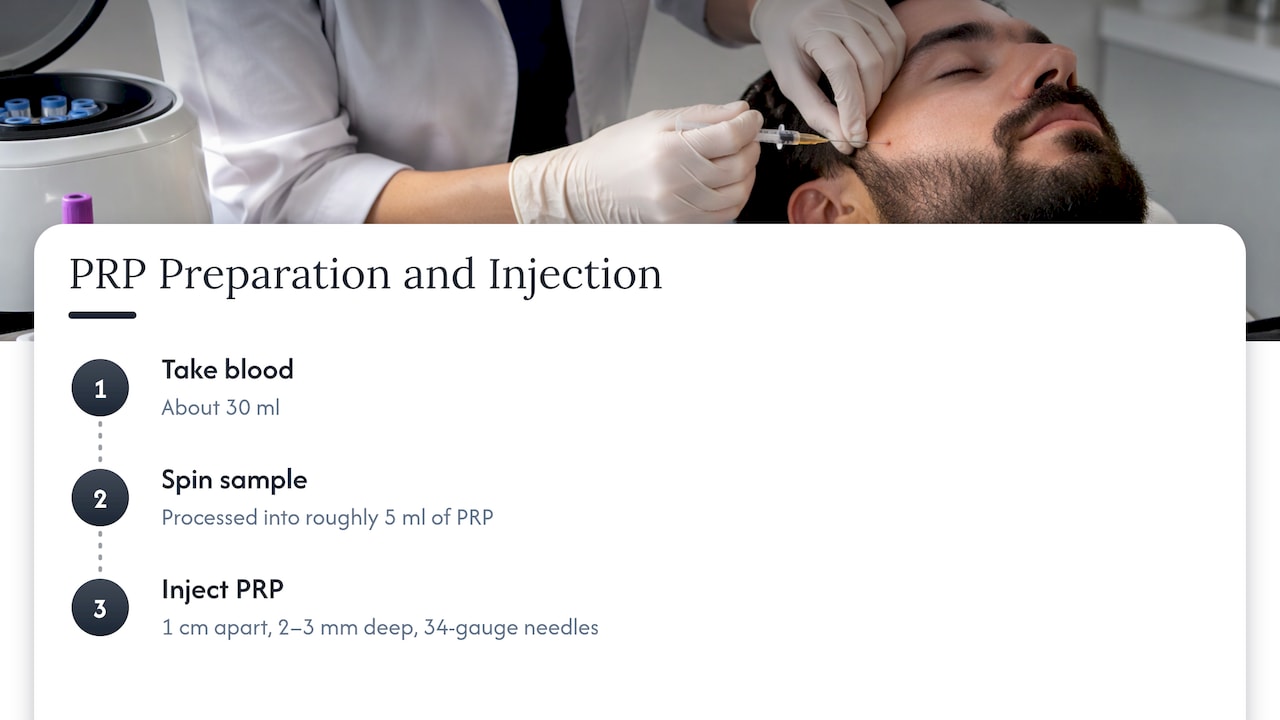
To make it, a clinician takes a small blood sample, spins it in a centrifuge to separate the platelets, and injects the concentrate back into the skin. In the published beard case report described below, about 30 ml of blood was processed down to roughly 5 ml of PRP, which was injected about 1 cm apart at a depth of 2 to 3 mm using very fine 34-gauge needles.
Because the PRP comes from you, there is no foreign product in the syringe. The idea behind beard treatment is the same as for scalp hair: to encourage dormant or struggling follicles back into an active growth phase.
What the research shows
The evidence comes in two layers: research on PRP for hair in general, and reports on beards specifically.
Evidence on beard hair
A 2020 case report in Cureus described a healthy 30-year-old man with alopecia areata barbae, an autoimmune condition that causes patchy loss of beard hair. He received three PRP injections at six-week intervals. Hair loss stabilised at the first follow-up, minimal regrowth was seen before the third injection, and there was robust regrowth at one year. The authors described it as the first reported successful PRP treatment of this condition and noted no adverse effects beyond minimal discomfort within 36 hours.
This is one man’s result, so it shows what is possible rather than what every client will get. It does show a clear pattern: treatment in a short series, then regrowth that builds over months rather than days.
Evidence on hair in general
Research on PRP for hair is much larger. A 2023 systematic review and meta-analysis pooled 27 controlled trials with 1,117 participants, covering androgenetic alopecia (pattern hair loss) and alopecia areata (patchy autoimmune loss). Compared with saline injections, PRP increased hair density over medium-term follow-up by an average of 25.6 hairs per cm², and no serious adverse events were reported.
A September 2025 meta-analysis found that activated PRP increased hair density and reduced recurrence compared with placebo. It also found that how the PRP is prepared matters: activated PRP performed better than the non-activated kind, which was associated with more adverse effects. That is one reason the preparation protocol and the clinic you choose count.
Is PRP the right option for your beard?
PRP is best matched to a beard that has follicles but is not using them well. Typical situations include:
- patches or thin areas on the cheeks, chin or jawline;
- facial hair that grows unevenly or in a sparse pattern;
- loss in small areas that has appeared over time;
- a wish for a treatment using your own biology rather than a topical product you apply every day.
It matters first to understand why the beard is patchy. Genetics decide how densely your facial hair grows. Autoimmune conditions such as alopecia areata barbae cause sudden, well-defined bare patches. Skin conditions, scarring, nutritional factors and stress can also play a part. Each has a different outlook, which is why a consultation should come before any injection.
If your patches appeared suddenly, if the skin looks inflamed, scaly or scarred, or if you notice hair loss elsewhere, mention it at your consultation. A clinician can review your history and decide whether PRP is appropriate or whether you need a medical check first. Our guide to London aesthetic consultations explains what that appointment covers.
If you are also noticing thinning on your scalp, our article on male hair thinning at the temples covers the causes and options.
What happens during a beard PRP session
A typical session follows these stages:
- Consultation and consent. Your medical history, medication and allergies are reviewed, photographs are taken, and you sign consent that covers risks and expected results. The ACE Group patient leaflet recommends exactly this, including a cooling-off period before treatment.
- Blood sample. A small amount of blood is drawn, as for a routine blood test.
- Processing. The sample is spun in a centrifuge to concentrate the platelets.
- Injection. The PRP is placed with fine needles across the thin or patchy areas of the beard.
- Afterwards. Mild redness or tenderness in the skin is common, and you can usually return to your day.
If you want to know how the injections feel, our article on how painful PRP hair treatment is describes the sensation in detail. The beard case report noted only minimal discomfort.
How many sessions and when to expect results
PRP is a course of treatment, not a single visit. In the published beard case, three injections were given six weeks apart, and the man was assessed again at one year. In wider hair research, regrowth is judged over months because follicles move through their growth cycle slowly.
In practice, this means:
- plan for a short series of sessions rather than one;
- allow several months before judging the result, as hair grows at a pace of its own;
- expect any improvement to build gradually, from stabilisation to thicker coverage.
Your clinician will set the number of sessions and spacing after assessing your skin and pattern of growth. For scalp treatment, our guide to PRP hair maintenance explains how top-up sessions are usually approached, which gives a good sense of how a course is planned.
Safety, preparation and who should avoid PRP
Because PRP uses your own blood, allergic reactions to the product are not the concern. The main considerations are your general health and what you take.
The ACE Group leaflet lists the situations where PRP may not be suitable:
- pregnancy or breastfeeding;
- a skin infection in or near the treatment area;
- autoimmune conditions;
- blood-clotting disorders;
- cancer;
- severe anaemia;
- medicines that affect bleeding or platelet function.
The same leaflet advises avoiding anti-inflammatory medicines for 5 to 7 days before treatment unless they are medically required or prescribed, and avoiding alcohol, fish oils and vitamin E for the same 5 to 7 days. Never stop a prescribed medicine on your own: tell your clinician about everything you take and follow their advice.
If you have one of the conditions above, including an autoimmune condition, the consultation is where your suitability is decided with a doctor-led team.
UK rules: why the clinic matters
In the UK, PRP is regulated as a medical treatment. According to the Chartered Society of Physiotherapy, the MHRA’s October 2023 position is that PRP used for medical purposes is an unlicensed medicine unless an exemption applies. Doctors are exempt when they supply PRP to a named patient during treatment, and they remain subject to the Blood Safety and Quality Regulations. Medical supervision is built into lawful UK PRP practice.
The Aesthetics Journal’s July 2026 report on joint guidance from the JCCP, CQC and MHRA adds that any PRP procedure for hair loss, or where a medical claim or diagnosis is made, is restricted to doctors and dentists working in CQC-registered facilities. The same report notes that hair restoration is a regulated activity when carried out by a regulated healthcare professional, and that a proposed licensing scheme for non-surgical cosmetic procedures in England currently places cosmetic PRP in the medium-risk category, with respondents asking for a stricter classification.
For you, this gives a simple checklist before booking:
- Is the treatment carried out by a doctor or medically trained professional?
- Is the clinic CQC-registered?
- Will you have a full consultation, with consent and photographs, before any injection?
The Aesthetics Room is CQC-registered and a member of the ACE Group, which is dedicated to patient safety. For wider guidance on choosing a clinic, see our article on how to choose top Central London skin clinics.
How much does beard PRP cost in London?
At The Aesthetics Room, PRP for facial hair is £258 per treatment, according to our published price list. Because PRP is normally delivered as a course, ask at your consultation how many sessions your pattern of growth is likely to need so you can plan the total.
For comparison, scalp PRP at our clinic is £450 and Vitamin Hair Therapy is £218. Our article on PRP hair treatment costs in the UK explains what drives the price of a session and what a course involves.
Our view
Patchy facial hair is rarely just a cosmetic question. We look at the whole picture: your history, the pattern of the patches, your skin and your general health. Only then do we recommend a plan.
PRP appeals to many of our male clients because it uses their own platelets and sits within a medical framework. The published beard case showed regrowth building over a year after three sessions, and wider research shows increased hair density with PRP. What gives the treatment its best chance is the preparation, the technique and a plan made for you.
That is why we treat it as medicine. Our practitioners are medically trained, the clinic is CQC-registered, and we belong to the ACE Group. You are consulted first, treated second.
Vishul
Book a consultation for facial hair PRP
If you are in London and want to discuss your beard, we offer in-person and virtual consultations, with clinics in Knightsbridge, Harley Street and Mayfair. Facial hair PRP is £258 per treatment, and you can see every treatment on our price list.
To book, start from The Aesthetics Room and choose the consultation that suits you.
FAQ
Can PRP help a patchy beard?
PRP is used for patchy facial hair because it is designed to support the follicles in the area. A published case report described robust regrowth at one year in a man with patchy autoimmune beard loss after three sessions. A consultation establishes the likely cause of your patches and whether PRP is a good match.
How long does it take to see results?
Hair grows slowly, so improvement builds over months rather than days. In the published beard case, the first follow-up showed stabilisation, minimal regrowth appeared before the third injection, and the clearest result came at one year. Your clinician will advise on timing for your own beard.
Is beard PRP safe?
PRP is made from your own blood, and a 2023 meta-analysis of 27 trials found no serious adverse events. Safety still depends on your health and medication, so tell your clinician about everything you take. Choose a doctor-led, CQC-registered clinic where consent and a full consultation come first.
Who should not have PRP?
The ACE Group leaflet lists pregnancy, breastfeeding, skin infection near the treatment area, autoimmune conditions, clotting disorders, cancer, severe anaemia and medicines affecting bleeding or platelets as situations where PRP may not be suitable. Your clinician will check these at consultation.
How much does PRP for a beard cost?
At The Aesthetics Room, PRP for facial hair is £258 per treatment. Because PRP is usually given as a series, ask at your consultation how many sessions you are likely to need.
Sources
- Successful Treatment of Alopecia Areata Barbae with Platelet-Rich Plasma, Cureus case report (2020)
- Platelet-rich plasma for the treatment of alopecia: a systematic review and meta-analysis (2023)
- Platelet-Rich Plasma in the Management of Alopecia: a systematic review and meta-analysis (2025)
- ACE Group patient leaflet on PRP
- Platelet-rich plasma injections, Chartered Society of Physiotherapy
- New PRP guidance released for hair treatments, Aesthetics Journal (July 2026)