


Most people who have an IV vitamin drip notice nothing worse than a small bruise or a tender patch where the cannula (the thin tube placed in the vein) went in. Serious problems are uncommon, but they are real, and almost all of them depend on who gives the drip, in what setting and after what checks. That is why the safest place for a drip is a CQC-registered clinic with medically trained staff, such as ours in Knightsbridge, Harley Street and Mayfair.
This guide sets out what can happen, how long it lasts, which symptoms need urgent help and what to look for before you book.
TL;DR
- The usual effects are mild and local: bruising, tenderness, a cool sensation or a metallic taste, and light-headedness if a drip runs too fast.
- Rarer risks include vein inflammation, infection, allergic reactions and, with excess doses, nutrient toxicity. They are managed by sterile technique, correct dosing and proper clinical oversight.
- Some effects appear in the days after a drip, so a calm hour in the chair does not mean the risk has passed. Know the warning signs.
- Tell the practitioner about your medicines, kidney or heart conditions and any pregnancy or breastfeeding before you start.
- Choose a regulated clinic with medical staff, a consultation beforehand and an emergency plan.
Table of Contents
- What is an IV drip, and why do side effects happen?
- Common side effects: mild, local and short-lived
- Less common risks worth knowing
- How long do side effects last?
- Symptoms that need urgent help
- Who needs extra care before a drip?
- What a safe IV setting looks like
- Before, during and after: a simple plan
- What about the feeling of being worse afterwards?
- Our perspective
- Booking with us
- FAQ
- Sources
What is an IV drip, and why do side effects happen?
An IV (intravenous) drip delivers fluids, vitamins or minerals directly into a vein. Because the nutrients bypass the digestive system, they reach the bloodstream at once. That is the appeal, and it is also the reason the process needs more care than taking a tablet: the body cannot filter, slow or refuse the dose the way the gut does.
A 2025 review of intravenous vitamin therapy identifies the main avoidable hazards as direct exposure of the bloodstream, inadequate sterility, inappropriate dosing and a lack of qualified clinical oversight. Every side effect below falls under one of those four headings, which is useful: each one can be addressed before the needle goes in.
If you want the background first, our guide to what a vitamin infusion is and how it works covers it in plain terms.
Common side effects: mild, local and short-lived
The effects you are most likely to meet are connected with the cannula rather than the vitamins:
- Bruising and tenderness at the insertion site. The 2025 review lists bruising among the effects of repeated or poorly performed IV therapy, and it is the most common reason people notice a drip afterwards.
- Mild vein irritation. Some solutions irritate the vein wall, which can feel like a cool, achy or stinging sensation along the arm during the infusion. Tell the practitioner at once: slowing the rate usually settles it.
- A metallic taste or a flushed, warm feeling. These are widely reported with certain vitamin and mineral mixes and typically pass within minutes.
- Light-headedness. The Merck Manual notes that rapid administration can lower blood pressure enough to cause light-headedness or fainting. A correctly paced drip, given while you are seated or lying down, is designed to avoid this.
- Mild itching or rash. This can be a sign of sensitivity to an ingredient. It deserves attention, covered below.
To reduce bruising, drink water beforehand unless told otherwise, mention if you bruise easily or take blood thinners, and keep gentle pressure on the site when the cannula comes out.
Less common risks worth knowing
These are the effects that justify choosing your provider carefully.
Vein inflammation and vein damage
Phlebitis is inflammation of a vein, causing a red, warm, painful cord along the arm. The 2025 review links repeated or poorly performed IV therapy with phlebitis, vein damage or collapse. Skilled cannulation, appropriate cannula size and rotating sites reduce the chance.
Infection
Any break in the skin is a route for bacteria. The same review reports that non-sterile administration can lead to abscess, bloodstream infection or sepsis. A German medicines-safety report describes a previously healthy 38-year-old who developed severe sepsis after contaminated intravenous vitamin C and needed intensive care. The lesson from such cases is that sterile preparation and clean technique are non-negotiable, even for healthy people.
Allergic reactions
Any infused substance can cause a reaction in someone sensitive to it. UK product information for an IV iron medicine describes itching with hypersensitivity, and says hives, swelling of the face, tongue or throat, difficulty breathing or chest pain may signal a serious allergic reaction needing immediate attention. Anaphylaxis (a severe, whole-body allergic reaction) is rare, but it is the reason the setting matters: staff must recognise it in seconds and have emergency equipment to hand.
Too much of a good thing
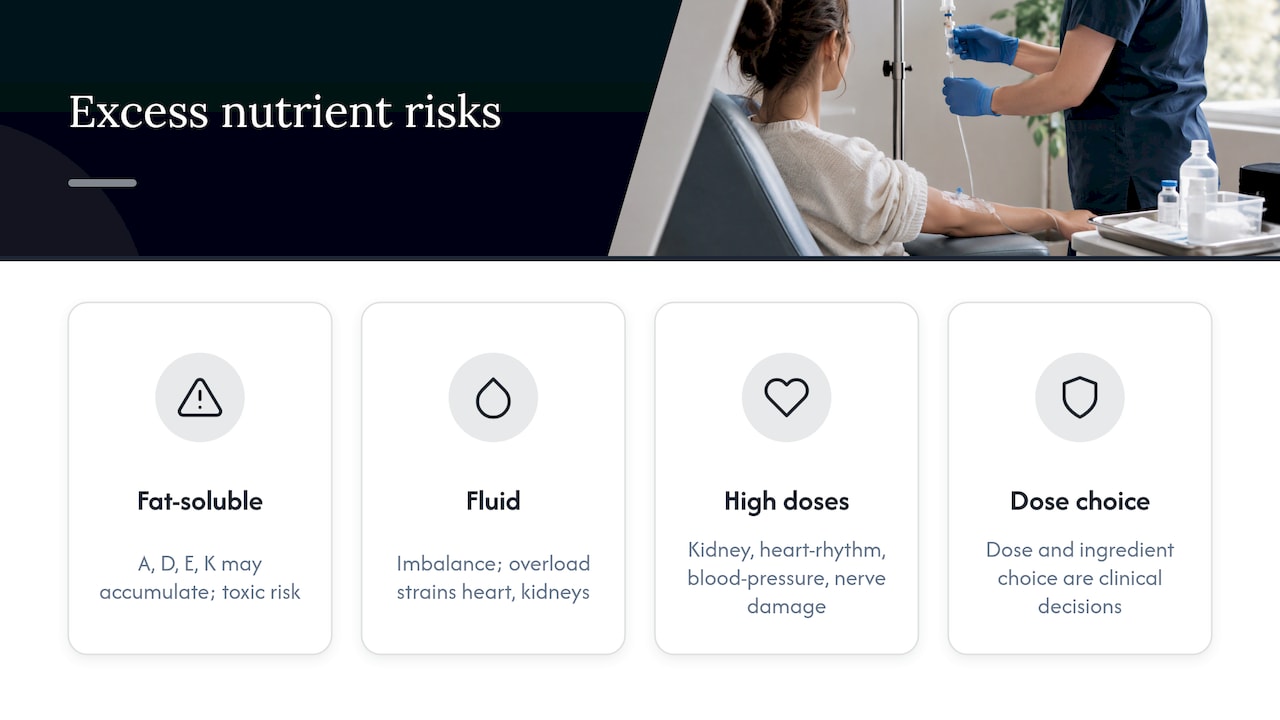
Vitamins and minerals are not harmless simply because they occur in food. According to the 2025 review, excess nutrients, particularly the fat-soluble vitamins A, D, E and K, can accumulate and become toxic. Inappropriate fluid volumes can also cause electrolyte imbalance or fluid overload, which affects the heart and kidneys. Mayo Clinic Press reports that very high doses of vitamins and minerals have been linked with kidney damage, heart-rhythm abnormalities, blood-pressure changes and nerve damage. Dose and ingredient choice are therefore a clinical decision, not a menu option.
The same principle applies to oral products. Taking large amounts of some supplements can have effects you would not expect, including on hair, as this overview of supplements that cause hair loss explains.
Rare procedural events
Incorrect insertion or technique can, in rare cases, cause thrombophlebitis (a vein inflamed by a clot) or air embolism (air entering the bloodstream). These are procedural errors, which is exactly why cannulation belongs to trained clinicians.
How long do side effects last?
The answer depends on the type:
| Effect | Typical timing | What to do |
|---|---|---|
| Bruising, tenderness | Appears within hours, fades over days | Gentle pressure, cool compress, mention anything that worsens |
| Metallic taste, warmth, flushing | During the drip, passes within minutes | Tell your practitioner so the rate can be adjusted |
| Mild itch or rash | During or shortly after | Tell the practitioner immediately; do not wait it out |
| Red, hot, painful cord along the vein | Hours to days later | Contact the clinic the same day |
| Fever, chills, spreading redness | Hours to days later | Seek urgent medical advice |
The important point comes from the ACCP position statement on hydration and vitamin infusion: many side effects develop in the few days after an infusion, so the absence of an immediate reaction does not exclude a later complication. Treat the 72 hours after a drip as a period to pay attention to your arm and your temperature, not just a time to feel refreshed.
Symptoms that need urgent help
These situations are about your safety, not about the clinic’s brand. Act on them straight away:
- Call 999 or go to A&E for swelling of the face, tongue or throat, difficulty breathing, chest pain, collapse or a rapidly spreading rash. These can signal a severe allergic reaction.
- Call 999 or go to A&E, or phone NHS 111 for advice, for fever with shaking chills, confusion, a racing heart or feeling suddenly very unwell in the days after a drip. Infection that enters the bloodstream can progress to sepsis, and it needs prompt medical assessment.
- Contact the clinic the same day for a red, hot, swollen or increasingly painful arm, or a lump that grows around the insertion site.
If you go to hospital, say that you have had an IV infusion, when, and which ingredients were in it.
Who needs extra care before a drip?
IV nutrition is not one-size-fits-all. A proper assessment matters most if you:
- have kidney, heart or liver conditions. High-dose vitamin C has been associated with kidney injury, and the Which? report on IV drips also cites liver problems linked with repeated IV iron and nerve damage linked with vitamin B6;
- take regular medicines. The Merck Manual gives examples: magnesium with blood-pressure tablets, and infused calcium with the antibiotic ceftriaxone, and interactions depend on the ingredients and doses;
- have abnormal potassium or magnesium levels. The Merck Manual says infusions containing these can cause arrhythmias or muscle weakness in such people;
- are pregnant or breastfeeding. The Merck Manual states that safety of IV vitamin therapy in pregnancy and breastfeeding has not been studied;
- have a history of allergic reactions, or a tendency to bruise or bleed.
The practical step is simple: bring a list of your medicines and supplements, and answer the health questions in full. If you are unsure whether a drip suits you, a consultation is the right place to ask. We offer consultations in person or virtually before any treatment is booked.
What a safe IV setting looks like
Because so much of the risk sits in the setting, the questions you ask before booking matter as much as the drip itself. The 2025 review and Which?’s December 2025 investigation point to the same checklist:
- A clear reason and an assessment. Someone qualified should review your history and explain why a particular formulation suits you.
- Informed consent. You should be told the ingredients, doses and the risks before you agree.
- Qualified, licensed healthcare professionals. Ask who inserts the cannula and what their registration is.
- Rigorous sterile technique. The review warns that spa or mobile settings may fall short of medical sterility standards. Single-use equipment and clean preparation are the baseline.
- An emergency plan. UK product information for IV medicines sets a clear standard: trained staff able to manage anaphylaxis, immediate access to resuscitation facilities and observation for at least 30 minutes after each injection, with treatment stopped at once if hypersensitivity occurs.
- Monitoring and a sensible rate. Infusion guidance for fluids such as glucose 10% calls for medical supervision, single use, a sufficiently slow rate and monitoring of electrolytes in the people who need it.
Which? also notes that cleanliness, infection control and staff qualifications can vary, because many wellness drips are not regulated as medicines. Regulation of the clinic is therefore worth checking. The Care Quality Commission (CQC) is the independent regulator of health and care services in England, and you can confirm a provider’s registration on its website. Our clinic is CQC-registered and a member of the ACE Group, which is dedicated to patient safety, and every treatment is performed by medically trained professionals.
For a wider view of how UK bodies approach this area, see our summary of what the NHS, ASA, CQC and NICE say about wellness IV services.
Before, during and after: a simple plan
Before
- Eat normally and drink water unless advised otherwise.
- Bring your medicines list, including supplements and anything bought over the counter.
- Mention allergies, recent illness, pregnancy or breastfeeding.
During
- Say straight away if you feel stinging, burning, dizziness, itching, a tight chest or palpitations.
- Expect the practitioner to check on you and to adjust the speed if you are uncomfortable.
After
- Keep the site clean and dry for the first few hours and avoid heavy lifting with that arm if it is tender.
- Check the site each day for three days: redness, heat, swelling or increasing pain.
- Note your temperature if you feel unwell. A fever is a reason to call.
- Spread out repeat drips as advised rather than stacking them, since repeated infusions are linked with vein problems and nutrient build-up.
Our guide to what happens during and after an IV infusion walks through the appointment in more detail, and the section on risks and who should avoid IV vitamin infusions is worth reading before you decide.
What about the feeling of being worse afterwards?
Some people feel tired, headachy or slightly nauseous after a drip. It can be linked with the rate of infusion, how much you had to drink, or simply an unrelated illness coming on. It should be mild and short-lived. If symptoms are strong, last more than a day or two, or come with a fever, treat them as a reason to contact the clinic or a doctor, not as something to push through.
Our perspective
The question we hear most is whether drips are safe. Our answer is that safety is built into the setting, not into the bag of fluid. A cannula placed by a trained professional, in a regulated clinic, after a proper conversation about your health, is a very different experience from one in a setting without any of that.
That is why we are CQC-registered, why we belong to the ACE Group, and why every treatment at The Aesthetics Room is performed by medically trained professionals. We build bespoke plans around the individual, and we look at wellbeing as a whole, inside and out, rather than offering one standard drip to everyone.
If you have a question about a side effect, a medicine you take or whether a treatment suits you, ask before you book. We would always rather answer ten questions than leave you with one worry.
Vishul
Booking with us
We offer IV vitamin therapy alongside a full range of medical aesthetic treatments at our clinics in Knightsbridge, Harley Street and Mayfair. If you prefer an injection to a drip, our Vitamin D Shot is £150. You can see what an IV drip involves financially in our guide to IV drip cost in Mayfair, or browse the full treatment price list.

Book an in-person or virtual consultation and tell us your health history and goals. We will recommend a plan that is right for you.
FAQ
Is IV therapy safe?
For most healthy adults, a drip given by a trained professional in a regulated clinic with sterile technique, a sensible dose and an emergency plan is well tolerated. The risks come mainly from poor technique, contamination, excessive doses and missing medical oversight, which is why the choice of clinic matters. A consultation beforehand lets the practitioner check your history and medicines.
How long do side effects last after an infusion?
Mild bruising and tenderness usually fade within days. Some effects, however, develop in the days following an infusion, so keep an eye on the site and your temperature for about three days. A fever, spreading redness or increasing pain needs prompt medical advice.
Can you get sepsis from an IV drip?
It is rare, but it can happen if a non-sterile drip or contaminated solution introduces bacteria into the bloodstream. Sterile preparation, single-use equipment and trained staff are the safeguards. If you develop fever, chills, confusion or feel suddenly very unwell after a drip, call 999 or NHS 111.
Why does my arm itch during or after a drip?
Mild itching can be a local reaction around the vein or a sign of sensitivity to an ingredient. Tell the practitioner immediately so the drip can be slowed or stopped. Swelling of the face, tongue or throat, difficulty breathing or chest pain is an emergency: call 999.
Are vitamin drips safe if I am pregnant or take regular medication?
They need a specific assessment first. The Merck Manual says safety in pregnancy and breastfeeding has not been studied, and that interactions depend on the ingredients and doses. Share your full medicines list with the practitioner and ask for advice before booking.
Sources
- To IV or Not to IV: The Science Behind Intravenous Vitamin Therapy (2025 review)
- Which?: IV vitamin drips investigation
- Merck Manual: Intravenous Vitamin Therapy (Myers’ Cocktail)
- Mayo Clinic Press: IV vitamin therapy and potential risks
- ACCP Position Statement on Hydration and Vitamin Infusion Clinics
- Monofer 100 mg/ml solution for injection/infusion: Summary of Product Characteristics
- Glucose 10% Intravenous Infusion: Summary of Product Characteristics
- Schwere Sepsis nach parenteraler Gabe von Vitamin C (case report)